https://www.mathplayground.com/ASB_IslandChaseSubtraction.html
I chose a math game that we use very often at my school. This website has games for almost any skill you can imagine for grades k-6. "Island Chase Subtraction" is an engaging, multiplayer online game available on Math Playground, designed to help students practice and master subtraction facts up to 12. In this wacky water race, students mentally solve subtraction problems to propel their boat forward, making it an excellent tool for developing mental math fluency. Its interactive and competitive nature, whether played as a whole group activity or independently on Google Classroom, significantly boosts student engagement. You can find the game here:
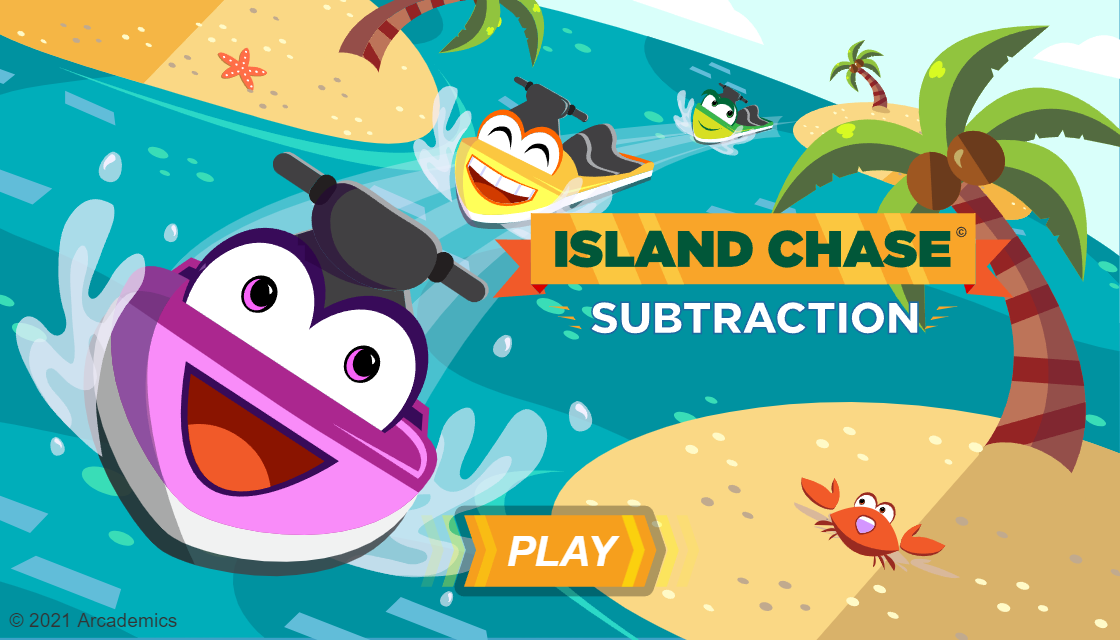

A way to scaffold this is to partner students up so they can work together. Another way I might scaffold this is to provide students with manipulative to use. Another differentiation technique I can incorporate is a punch card. If a student is struggling with subtraction with numbers greater than 8 I can have them practice those ones more using the game and give them a punch for every time they get a certain number correct. This can help build up confidence as well.
There are many ways I can use this to assess students literacy practices as well as the objective of subtraction facts. Beyond observing their in-game performance (speed and accuracy), I would incorporate reflective practices. Students could be asked to verbally explain their mental math strategies for specific problems, either to a peer or to me, fostering mathematical communication. They could also write short sentences about the game, developing their written mathematical literacy. Furthermore, small-group discussions after playing the game would allow me to assess their ability to articulate mathematical concepts and engage in collaborative problem-solving. Finally, traditional formative assessments, such as exit tickets requiring them to solve a few subtraction problems without the game, would gauge their retention of facts and strategies. Games require students to problem solve thus allowing for assessment easily from a game (Shaffer&Gee, p. 12, 2010).
References:
Shaffer, David & Gee, James. (2010). Looking where the light is bad: Video games and the future of assessment. Phi Delta Kappa International EDge. 6.


Module 7 Blog Post 6 Reply #2:
ReplyDeleteI love how you highlighted the immediate nature of the feedback offered to students by this game. I am curious, does the game offer in-the-moment explanations of how to solve the problem or correct errors that may have occurred in the process of completing the problem? I noticed you mentioned that this game only goes to subtractions facts as high as 12, yet your standards dictate students need to be able to subtract as high as 20. Are you aware of any additional games that meet the need to incorporate the whole standard by supporting subtraction facts up to 20? Additionally, in my experience, I have seen how competitive games can both encourage and discourage young learners. Do you have classroom policies and procedures in place to ensure students do not become too competitive and hurtful as a result of the competition created within this game? I’m not familiar with younger levels, however I have seen first hand how adolescent students will openly bully each other by means disguised as “friendly banter” during competition games. Such comments may be done between friends within the classroom but the language is often still hurtful to the intended student. I also really appreciate your consideration for using manipulative in conjunction with the game to support subtraction skills. I wonder if there are virtual simulations to demonstration subtraction manipulation? Overall, thank you for sharing your game, it is very interesting to read about and see how you intend to use it within your classroom!
Emily,
ReplyDeleteAs someone who also chose an ABCYA game I am so happy to see that another educator sees the beauty in this website. The possibilities and games are endless. I love how you can work on so many different skills at once. I also enjoy that there are different levels for the game that you chose. I also enjoy that this 'feels' like a game. After 5 questions you can play the game where you have to try to line up the ball with the circle to try to make your shot. I wonder, with the many different modes and plenty of differentiation, if I could use this as a station in my Math RTI as a 'fun Friday' activity. I typically play Blooket with the skill that we had worked on this week. I think this would be another great opportunity for students to use.
Emily,
ReplyDeleteAs a high school math teacher, it is honestly so refreshing and inspiring to see how dedicated you are to supporting students in building foundational math skills through engaging tools like Island Chase Subtraction. I can't tell you how many students came into Algebra still struggling with basic facts, and I can say it is 100% not because they are incapable but because those early skills were not practiced in ways that really stuck. The fact that you are using gamification to make subtraction meaningful, memorable, and even fun is AMAZING!
I love how you are not just using the game for engagment but also weaving in intentional scaffols like manipulatives, peer partnerships, and punch cards for motivation. Your use of the game's built-in-data to inform next steps really shows a thoughful balance of tech and teaching.
Thank you for sharing!